NMLS #34690 · Equal Housing Lender ·
Call:(516) 264-7040info@lmbankers.com
info@lmbankers.com
NMLS #34690 · Equal Housing Lender ·
Call:(516) 264-7040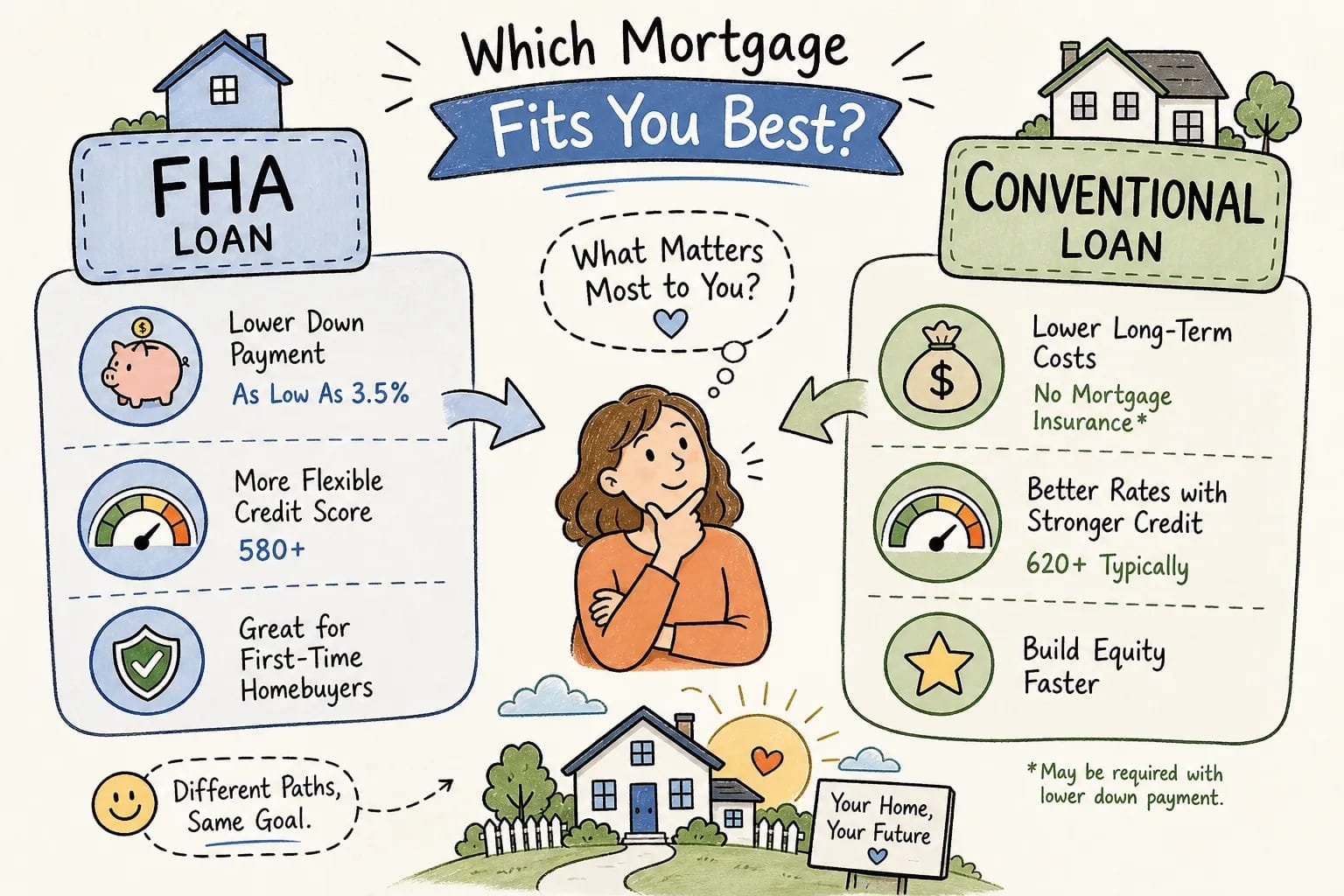
If you’re weighing which loan is better, FHA or conventional, the honest answer is that neither is automatically the right choice. Most first-time buyers assume FHA is the safe, easy option. That assumption costs some buyers thousands of dollars over the life of their loan. The right call depends on three numbers that define your situation: your credit score, how much you’re putting down, and how long you plan to stay in the home.
This isn’t a generic rundown of features. This comparison is built around real buyer profiles so you can locate yourself in the data and make a clear call. At Lakeview Mortgage Bankers, we run this exact side-by-side analysis for buyers across New York, Florida, and Georgia every day. The goal here is to give you that same clarity before you ever sit down with a lender.
Before getting into the nuance, here’s the core comparison across the factors that matter most to first-time buyers. Use this as a reference point as you read through the deeper analysis below.
| Factor | FHA Loan | Conventional Loan |
|---|---|---|
| Minimum down payment | 3.5% (580+ credit score) | 3% (with qualifying program) |
| Minimum credit score | 580 (3.5% down); 500 (10% down) | Typically 620 |
| Mortgage insurance type | MIP (upfront + annual) | PMI (monthly only) |
| Insurance cancellable? | Only with 10%+ down (after 11 years) | Yes, at 80% LTV (auto-cancels at 78%) |
| 2026 baseline loan limit (1-unit) | $541,287 floor / $1,249,125 ceiling | $832,750 baseline / $1,249,125 high-cost |
| Eligible property use | Primary residence only (2, 4 units with owner occupancy) | Primary, second home, investment |
The table captures eligibility thresholds, not true cost. A borrower who qualifies for both loans on paper may still pay dramatically different amounts over 30 years depending on credit score and down payment. That’s where the real decision gets made.
The minimums in that table are just the starting line. What actually determines whether FHA or conventional is better for you is how your credit score and down payment interact with each program’s pricing structure.
Credit score ranges break down like this when comparing FHA and conventional costs:
The LLPA system is worth understanding because it’s invisible to most buyers. Conventional loans carry risk-based pricing adjustments tied to your credit score and LTV ratio. A buyer with a 640 score putting 5% down will absorb significant pricing hits that a borrower with a 760 score never sees. FHA’s pricing works differently. Its mortgage insurance rates are standardized by LTV and loan amount, not credit score. That’s why FHA can actually be the lower-cost option for borrowers in the 620 to 680 range, even when conventional is technically available.
At 3% to 3.5% down, the practical cost difference between FHA and conventional is small on paper but significant in reality because of how MIP works. At 5% down, the math starts tilting toward conventional for buyers with solid credit, since PMI at this LTV can cost less per month than FHA’s annual MIP and will eventually cancel. At 10% down, the comparison sharpens considerably. FHA’s annual MIP runs for 11 years minimum at this down payment, while conventional PMI may cancel in 4 to 6 years depending on appreciation and amortization. On a $300,000 home, that difference in insurance duration alone can mean tens of thousands of dollars over the loan term.
This is the section that surprises most buyers. The monthly cost difference between FHA and conventional can look modest until you calculate what it adds up to over 30 years.
FHA charges mortgage insurance in two pieces. The upfront MIP is 1.75% of the base loan amount and is almost always rolled into the loan balance. On a $289,500 loan (3.5% down on a $300,000 home), that’s approximately $5,066 added to what you owe before you make a single payment. Then comes the annual MIP, which for most 30-year loans with less than 10% down runs at 0.55% annually, about $133 per month on that same loan. The critical detail: if you put less than 10% down, this annual MIP lasts the full life of the loan. There is no way to cancel it without refinancing into a new mortgage.
Run that math over 30 years and the numbers are significant. FHA mortgage insurance costs at 3.5% down can exceed $50,000 over the full loan term when you account for both the upfront premium and lifetime annual MIP. That number declines as the loan balance drops, but the insurance never stops.
Conventional PMI ranges from roughly 0.5% to 2% annually, with costs driven heavily by your credit score and LTV ratio. A borrower with a 740+ score putting 5% down may land at PMI below 0.55% annually, competitive with or cheaper than FHA’s annual MIP on a monthly basis. A borrower with a 620 score at the same down payment could see PMI climb past 1.5%, which makes FHA look attractive by comparison.
The decisive advantage for conventional borrowers with solid credit: PMI cancels automatically at 78% LTV and can be requested at 80%. On a $300,000 purchase with 5% down and a 740 credit score, conventional PMI over the life of the loan might total $16,600 to $29,300 versus the $50,000-plus figure for FHA at 3.5% down. That gap is real money.
FHA isn’t just a fallback for buyers with lower scores. In specific situations, it’s genuinely the better-priced option. Here’s when FHA loan benefits work most in your favor.
If your score falls between 580 and 640 and you have limited cash reserves, FHA is frequently the smarter choice. Conventional lenders apply LLPAs at lower credit tiers that inflate both the interest rate and overall costs in ways that make FHA’s standardized MIP structure more competitive. FHA also carries higher DTI flexibility, accommodating ratios up to 43% under standard manual underwriting and potentially up to 50% with compensating factors. For buyers carrying student loans or car payments, this flexibility can be the difference between qualifying and not qualifying at all.
FHA allows buyers to purchase a 2 to 4 unit property with as little as 3.5% down, provided they occupy one unit as a primary residence within 60 days of closing. Rental income from the other units can help with qualification, a meaningful advantage for buyers trying to offset their mortgage payment. One important threshold to know: for 3 to 4 unit properties, FHA requires a self-sufficiency test where 75% of projected market rents must cover the full PITI payment. If the property clears that bar, this is a legitimate wealth-building entry point. Conventional financing at the same down payment is significantly harder to structure for a multi-unit purchase, making FHA the more accessible path for first-time house hackers with limited savings.
Conventional lending wins decisively in specific scenarios, particularly as credit scores and down payments climb.
For a buyer with a 700+ credit score putting down 5% to 10%, conventional PMI will often cost less per month than FHA MIP and the PMI itself won’t run the full loan term. At 5% down with a 720 score, annual PMI may fall in the 0.55% to 0.80% range, competitive with or below FHA’s 0.55% annual MIP once you factor in FHA’s upfront premium. At 10% down, the comparison tips clearly toward conventional for most buyers with solid credit. FHA MIP still runs for 11 years at that down payment level, while conventional PMI typically cancels in 4 to 6 years as the loan balance amortizes and property values rise. Over a 30-year timeline, that’s a substantial cost difference in favor of conventional.
In 2026, the FHA floor limit in low-cost counties is $541,287, while the conventional conforming baseline is $832,750 nationwide. In low- to moderately priced counties, a buyer targeting a $650,000 loan might exceed FHA’s limit entirely while staying within the conventional conforming threshold.
In the markets Lakeview Mortgage Bankers serves, this plays out directly. Nassau County and Suffolk County on Long Island both have FHA limits at the national ceiling of $1,249,125, so high loan amounts aren’t an FHA barrier there. But in Fulton County, Georgia, the FHA limit sits at $571,550, while the conventional conforming limit still extends to $832,750. For buyers in those markets targeting larger loan amounts, conventional isn’t just preferable, it may be the only conforming option available.
Here’s how the decision maps across four common buyer profiles. Use these as a starting framework, not a final answer.
Before signing any loan estimate, get clear answers to these questions:
At Lakeview Mortgage Bankers, this side-by-side comparison is exactly what we walk buyers through across New York, Florida, and Georgia. We pull real loan estimates for both options using your actual numbers so the decision is based on math, not assumptions. Our same-day pre-approval process and access to FHA, conventional, VA, and USDA programs under one roof means you’re not guessing at a loan type, you’re choosing the one that costs you less over the time you plan to stay in the home.
FHA and conventional each win in specific situations. The outcome is determined by your credit score, down payment, how long you plan to stay in the home, and the conforming loan limits in the county where you’re buying. Below 620, lean toward FHA. Above 700 with 5% or more down, run the conventional numbers carefully. Above 10% down with solid credit, conventional almost always saves more over the full loan term.
The smartest move you can make is to get actual loan estimates for both options with your real numbers before committing to either path. Lakeview Mortgage Bankers offers free consultations and side-by-side loan comparisons, so if you’re still asking which loan is better, FHA or conventional, let real numbers answer that question for you. Reach out to our team to get started.
It depends on your credit score and down payment. Buyers with scores below 640 or limited savings often benefit from FHA’s flexible qualifying standards and standardized mortgage insurance. Buyers with scores above 700 and at least 5% down typically save more with conventional over the life of the loan because PMI cancels and pricing is more favorable.
If you put less than 10% down, FHA mortgage insurance premium (MIP) lasts the full 30-year loan term and can only be removed by refinancing into a new mortgage. If you put 10% or more down, MIP drops off after 11 years.
FHA loan benefits include lower minimum credit score requirements (580 for 3.5% down), standardized mortgage insurance that doesn’t vary by credit score, higher debt-to-income ratio flexibility, and easier qualification for multi-unit purchases. These advantages are most valuable for buyers with lower credit scores or tighter cash reserves.
Conforming loan limits set the maximum loan amount for each program by county. In 2026, the conventional conforming baseline is $832,750, compared to an FHA floor of $541,287. In counties where the two limits differ significantly, buyers targeting higher loan amounts may find FHA unavailable and need to use conventional financing, or explore jumbo loan options.